Modern Social Media Live Stream Button: A Practical Guide to Design Assets and Implementation
In the rapidly evolving landscape of digital content creation, visual identity is often the first point of contact between a creator and their audience. The Modern Social Media Live Stream Button has emerged as a critical component in this ecosystem, serving not just as a functional indicator but as a dynamic branding element. Whether you are building a custom streaming overlay, designing a mobile app interface, or creating promotional materials for an event, the choice of graphical assets can significantly impact user engagement and perceived professionalism.
This article explores the specific attributes of modern live stream icons, focusing on the distinct advantages of high-quality 3D render designs. We will examine how these assets compare to traditional flat designs, evaluate the technical benefits of editable formats like PSD and JPG, and provide guidance on selecting the right resources for your specific project needs.
Understanding the Distinct Features of Modern Live Stream Icons
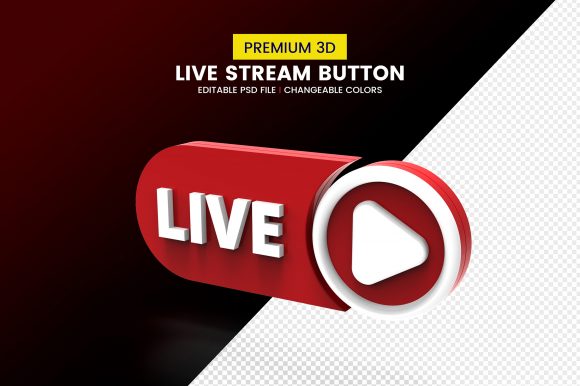
The term "Modern Social Media Live Stream Button" refers to a specific category of digital graphic designed to represent active broadcasting across various platforms. Unlike generic icons that might have been standard a decade ago, contemporary designs leverage advanced rendering techniques to create depth, texture, and realism. A key characteristic of these assets is the 3D render icon badge isolated design with transparent background.
This isolation is crucial for designers. It allows the button to be placed over any backdrop—whether it is a complex video game scene, a dark studio setup, or a bright marketing website—without requiring time-consuming manual editing to remove backgrounds. The transparency ensures that the icon integrates seamlessly, maintaining its visual integrity regardless of the underlying color scheme.
Furthermore, the modularity of these buttons is a primary selling point. Users can easily modify the size and color to align with their brand guidelines. This flexibility transforms a static image into a versatile tool. For instance, a streamer who primarily uses red and black branding can instantly recolor a blue-tinted icon to match their channel's aesthetic without losing the detailed lighting effects inherent in the 3D render.
Evaluating Formats: The Value of Editable Files
When evaluating design resources, the file format often dictates the utility of the asset. The product inclusion typically mentioned in high-quality design packages involves both High-resolution JPG File and Editible PSD File options. Understanding the difference between these two formats is essential for making an informed decision based on your technical skill level and project requirements.
- High-resolution JPG Files: These are ideal for users who need immediate deployment. Once downloaded, a JPG is ready to use in web browsers, social media posts, or video overlays without further processing. The high resolution ensures that the image remains crisp even when scaled up for large displays or printed merchandise. However, the tradeoff is rigidity; once saved as a JPG, the colors and layers are flattened, meaning you cannot change the hue or adjust individual elements later.
- Editable PSD Files: Photoshop Document (PSD) files offer a layer-based approach that provides maximum control. For professionals or hobbyists familiar with graphic design software, this format allows for granular adjustments. You can isolate the glow effects, change the metallic textures, or swap out the icon shape entirely. While this requires more effort and specific software knowledge, the long-term value is higher because the asset can be adapted for future projects without needing to purchase new graphics.
The combination of both formats in a single download represents a balanced approach. It caters to both quick-turnaround scenarios where speed is paramount and long-term projects where customization is necessary.
Comparing 3D Renders with Flat and Vector Alternatives
Designers often face a choice between three-dimensional renders and other stylistic approaches, such as flat vector graphics or simple 2D illustrations. To determine if the Modern Social Media Live Stream Button is the right fit, one must weigh the strengths and limitations of each style.
3D Render Icons excel in creating a sense of presence and premium quality. The use of lighting, shadows, and gradients mimics real-world objects, which can make a UI element feel tactile and engaging. In a crowded digital space, a 3D badge can stand out more effectively than a flat icon, drawing the viewer's eye to the "Live" status. This makes them particularly suitable for gaming overlays, YouTube thumbnails, and high-end corporate presentations where visual impact is a priority.
Conversely, Flat Vector Designs offer superior scalability and performance. Because they rely on mathematical paths rather than pixel data, vectors can be resized infinitely without losing quality. They also tend to load faster on websites, which is a critical factor for SEO and user experience on slower connections. If your project involves a minimalist interface or requires rapid loading times, a flat design might be the more pragmatic choice.
Simple 2D Illustrations sit somewhere in between. They often convey a friendly, approachable tone that fits well with lifestyle brands or educational content. However, they may lack the technical sophistication that a 3D render provides. When choosing between these options, consider your target audience. Tech-savvy gamers might appreciate the polished look of a 3D render, while a community-focused blog might prefer the warmth of a hand-drawn illustration.
Strategic Use Cases and Decision Factors
Selecting the appropriate design asset depends heavily on the context in which it will be used. The Modern Social Media Live Stream Button is not a one-size-fits-all solution, though its versatility makes it applicable to a wide range of scenarios.
For Content Creators and Streamers, the ability to customize color and size is invaluable. A streamer might need a small version of the button for a mobile app notification and a large, glowing version for their Twitch overlay. The availability of an editable PSD file allows them to tweak the brightness to ensure visibility against different game scenes. Additionally, the transparent background ensures the button does not obscure important gameplay footage.
In the realm of Web Development and App Design, the high-resolution JPG is often the preferred delivery method. Developers can integrate the image directly into the codebase without worrying about compatibility issues. The clean edges provided by the isolated design prevent awkward artifacts around the button, ensuring a professional appearance across different screen resolutions.
However, there are situations where this specific type of asset might not be the best choice. If you are designing a system with strict accessibility requirements, complex 3D gradients can sometimes reduce contrast ratios, making the button harder to read for users with visual impairments. In such cases, a simpler, high-contrast flat design with clear typography might be more effective. Similarly, for print materials where color consistency is strictly regulated (such as CMYK printing), a 3D render optimized for RGB screens might require significant adjustment to avoid color shifts.
Maximizing Value Through Customization
The true power of a modern design asset lies in its adaptability. The statement that you can "easily modify the size, color" is not merely a feature but a workflow enhancer. By utilizing the included Zip File containing both raster and vector-compatible layers, users can iterate on their designs rapidly.
Consider a scenario where a marketing team launches a campaign for a new product launch event. They start with the base 3D render. Using the PSD file, they adjust the color to match the product packaging. They then resize the button for use in email headers, social media banners, and physical posters. Because the original source files are preserved, they can revert changes or create variations for different demographics without starting from scratch. This efficiency reduces the overall cost of production and accelerates time-to-market.
Feedback loops are also essential in this process. As noted in many design communities, feedback is always welcome. Engaging with the broader user base can lead to discovering new use cases or identifying potential improvements in the design. For example, users might suggest adding a pulsating animation effect to the 3D render for video applications, prompting the designer to release an updated version with motion capabilities.
Making the Final Choice
Ultimately, the decision to invest in a Modern Social Media Live Stream Button should be driven by the specific goals of your project. If your priority is visual impact, brand consistency, and the ability to customize the asset for multiple platforms, the combination of 3D rendering and editable formats offers a compelling advantage over static alternatives.
While flat icons and simple vectors have their place in minimalist and performance-critical designs, the depth and realism of modern 3D badges provide a unique opportunity to elevate a project's aesthetic. By understanding the tradeoffs between file formats and design styles, creators can select resources that not only look good but also function effectively within their intended environment.
Whether you are a seasoned designer looking for a high-quality base to build upon or a beginner seeking a polished element to enhance your content, the availability of high-resolution and editable options ensures that you have the tools necessary to succeed. The key is to align the technical specifications of the asset with the creative vision of your project, ensuring that every element serves a purpose in communicating your message clearly and effectively.